There aren’t a lot of words to use ten years after the worst words are first spoken. What is there to say when I can hardly grasp that a full decade has passed since I held a very sick boy through the night wondering what could possibly be wrong only for our family to be ushered in the morning into blood tests and hours later an ER and an ambulance ride and an oncology wing of a children’s hospital?
I have written those series of words so many times that I no longer think them when I write them. They are a well-rehearsed script for a woman whose life I do not recognize. I was a mother to a boy who was very sick, but I am now a mother to a girl who is not, who is twice his age. I scarcely remember that scared mother. And I am that mother. My brain cannot grasp this with any amount of logic.
For the past few years it has been difficult to write or say much of anything. People grow uncomfortable talking about loss after so long, even if they miss him too. I grow uneasy not knowing what to say. I meet new people now, parents of my daughter’s peers, and I find myself reassuring them when they learn of my boy, when they are sorry for my loss, when they cannot imagine the depths of my pain. I tell them sometimes that it’s okay, that mostly I am okay. I tell them that it is awful, that they should not try to imagine because it is far, far, far worse than imaginations can entertain. I say too much. I say too little.
The words that carried me through the diagnosis and the treatments and the death and the grieving and the longing and the missing are themselves so fleeting.
I miss them. I need them.
I miss him.
I used to feel that in keeping the telling alive, I kept him here. I kept him closer to me, to everyone else, and that meant I was coping or healing or something. It was something to steady me when the pain rocked me hard. In losing the words, what happens to him? But it was easier then to talk about the timbre of the pain, easier to puzzle it out. It was fresher, the fluency crisp. Now, I go weeks without giving the grief a name. It takes the quality of sunlight shifting, calendars growing swirly with birthdays and school. It takes the days and my moods growing equally shorter and less predictable, tears coming easier, to begin to grasp that it is here.
Oh, hello, Grief. You are looking different now, aren’t you?
Crunchier, dustier, muddled and muddied up with new sorrows and losses. A whole pandemic. Grief begins to look like a stranger in a store coughing near still-masked me, and me feeling rage well up, and when it does, tears spilling out along with the muffled and fast-tracked words, “My son had leukemia and died,” and I am shocked and the stranger is shocked because I wasn’t expecting that dark visitor, and certainly neither was he, but there it is, ugly and uncomfortable, words sitting in thick air, and I am here still just needing to protect my living child and my dead child from invisible predators.
There is a shortage of eloquent words for this stage of grief. Apologies are about all I can muster.
Maybe it’s a supply chain issue. Not enough to go around for so much weltschmerz and a mother’s patina-coated grief too.
Maybe words are overrated. Maybe they will return. I try not to agonize over it too much until days like these when I need them so.
Ten years. Soon his thirteenth birthday. Another five months and the tenth anniversary. The years keep piling up; the words keep floating away.
Caemon, almost three, a couple of weeks from diagnosis.
When the sun rose this morning, my eyes popped open, and instantly I was anxious, my belly full of panic. I took a deep breath and acknowledged the day: August 20th. The day everything changed. Seven years ago, this was the worst day of my life thus far.
As I lay there, my daughter sleeping next to me, I curled into myself, tried to control the anxiety, tried to find what I was to do with this date. My mind would flit toward the trauma, edging now and then toward the phone call or the ambulance ride, and then back to the now, back to the biting anxiety in my gut. Too long I have worked on not reliving that day. I do not need to sink back into the feeling of standing in the thick August heat outside of that Santa Rosa ER, chilled and shivering uncontrollably from the shock. I don’t need to place myself in the moment of sinking to the cold hospital floor as the enormity of the ambulance ride and the paper signing and the oncology wing pulled me down. Those moments of terror were awful the first time. They are awful each time I plunge into them, and while in the early years I thought that I had to relive them to remember him, the wisdom of time with my grief tells me otherwise.
Still, without all the reliving and the retelling, what is a diagnosis day? What am I to do with one of the worst, most dread-filled days of my life?
My daughter woke as I stared at her, pondering all of this. She was hungry, wanted waffles. Her brother wanted waffles in the hospital. I told her so. We made them while I cried silently, her expert whisking of the batter in the blue bowl, her favorite and his, swinging me between then and now.
Yes. This is what we do now. We make waffles. We tell stories.
But still the date sat, unsettled, and as I made my way through it, trying so hard to be normal–to plan my classes and have lunch with my mom and even drive down the road, I was pulled so heavily to my grief, and my grasping for normal felt fruitless. I came home and slept, awakening again to the aching, sinking tugging of grief.
Some years’ anniversaries have not been this forceful, but this year, I found it was not just my grief for Caemon that weighted me down. Rather, it was the grief for me, for that mom I was then who had to endure such agony and still had so much more to go. It was grief for me now, for the innumerable struggles that began with that day and continue now. That day formed a snowball that became such a devastating avalanche, one that mowed down my self image, my marriage, my sense of security, and, yes, of course, my little boy.
I ended the day with a big cry as I made my daughter’s lunch for tomorrow. I wept as I packed some of their shared favorites–the pumpernickel pretzels, the yogurt, the watermelon. And then I sat, sunk all the way down to the floor like I did seven years ago. I sobbed as I grieved for my daughter, that she will never know the mother I was to him because today, seven years ago, I was wholly and irrevocably changed. I let tears pour down for my precious boy and all this day forced him to endure and forced me and his mama to endure and all we will always endure because of cancer. I cried until I couldn’t anymore.
I still do not know what to do with today, but in three minutes it is over. As I did seven years ago, I survived, and sometimes that is all one can do.
Seven days post diagnosis. There aren’t photos of this day or the days in the PICU.
Four years ago, on December 26th, I was nearly ten weeks pregnant. Jodi and I were going for an ultrasound, though, to confirm this tenuous piece of news because my doctor was concerned the baby might not be developing. It was a day of such uncertainty, the greatest terror I had felt since the day of my miscarriage a few months prior, and before that since the death of my son. However, within moments of the ultrasound tech placing a blob of warm gel on my belly and moving the transducer around, there on the screen was a little peanut-shaped blob with an unmistakable flickering heartbeat. My eyes poured tears, and relief transformed those tears into laughter, into hope.
Today, that little blob with the flickering heart is my vibrant daughter. Yesterday, on December 26th, my daughter turned three years and five months old. Three years, five months. That amounts to 1,249 days I have spent with this wondrous child—exactly the same number of days I spent with her brother. And today, today I have a child who has been on this earth for 1,250 days, and that I have never known before.
Before my daughter was born, Jodi and I took on the task of finding a new pediatrician. It was important to us both to find someone who understood what we had gone through, who would pay extra attention to our daughter. Just in case. The doctor we found had been in medicine for decades. He was sharp. He was warm. And he had known too many bereaved parents. I remember the wisdom he shared that day as we sat in his office as my daughter rolled around in my belly. He told us it would be hard those first few years, that we would probably overreact, that we would probably be hyper-vigilant—that he would be too. And he said that when our daughter grew to be the age Caemon was when he died, it would start to get better. He had seen it time and again. One day, these two bereaved mothers would relax into parenting what he predicted and hoped would be a healthy child.
And here we are. We have reached what he called “that magical age.” My daughter is now older than her big brother ever was, ever will be. She is healthy. She is wildly articulate. She is moody and energetic and willful and spirited and empathetic and curious and funny and wise, so wise. She is so much of her brother and she is so much just her.
I have watched her these months as she entered three. I didn’t know what it meant to have a three-year-old out of the hospital, a three-year-old without leukemia, a three-year-old without chemo and pain meds and steroids and all of the hardships that came along with that life with my boy.
As it turns out, it’s not that different in many ways. She has strong opinions, big feelings. She tells me regularly that her name is not her own, that she isn’t anyone—the very same existential declarations that led me to find the “Croc” moniker for Caemon. I’m left wondering from time to time if maybe it wasn’t morphine that made him reject his name, that maybe it wasn’t always feeling sick that made him protest returning to his room. I am learning that three-year-olds, sick and well, crave control of their situations, need boundaries to feel safe in their worlds, require the comfort and security of their parents’ arms to navigate new feelings and experiences. Of course, it’s different parenting a child in the hospital, but there is an odd comfort in knowing that my son was kind of a normal kid in some ways—as normal as my quirky offspring can be anyway.
With this knowledge, I don’t mind hearing my daughter proclaim that not only is she not her name, but that she is also not a child, my daughter, a baby, a dinosaur, a dragon, a cat, or funny. And while her emotional meltdowns make me sad for her, I don’t panic when she loses control. I just sit on the floor, open my arms, and let her collapse into me like he did so many times. I am her home base as I was his. She fits, not exactly where he did, but similarly, perfectly.
But what is different is that she is healthy. This year has meant preschool, something Caemon never fully experienced. And with preschool has come preschool colds—seemingly one after another. She has had some fevers. She has spent days wanting nothing but to curl herself up in my arms. The difference is that so far (and you know I have to say that), she recovers without incident. Her coughs fade away. Her ears remain clear. She bounces back and shows me time and again what a healthy child’s immune system is meant to do. Every time, I marvel, and every time, I also grasp just how sick he was for so long.
Of course, the differences span far beyond her health as we enter these unfamiliar months while she continues to grow and develop and learn. My daughter sings “Rudolph the Red-Nosed Reindeer” and dances her own made up “dragon dance.” She is obsessed with dinosaurs and horses, and she plays with toys and (usually) not medical supplies. She stomps in puddles and dresses in costumes and loves to get messy. She is making friends who are children (without one nurse or syringe pump among them), is on her first winter break, had her first holiday performance at school. And like most little sisters, she looks up to her big brother, tries to emulate him through her interpretation of who he was. Each day of her 1,250 on this planet thus far, she has reminded me that she is her own person and always will be. There is no danger of her taking on the role of replacement child, and as each day passes, I believe I may very well see her grow up.
My son’s favorite song in his final five months was a Jack Jonson song called “Supposed to Be.” Every time it came on, he wanted me to hold him, dance him, and as I did, he listened to every word, every note so intently. The lyrics were simple:
Maybe it’s up with the stars
Maybe it’s under the sea
Maybe it’s not very far
Maybe this is how it’s supposed to be
Maybe this is how it’s supposed to be
Maybe it’s trapped in a jar
Something we’ve already seen
Maybe it’s nowhere at all
Maybe this is how it’s supposed to be
Maybe this is how it’s supposed to be
Looking forward as we rewind
Looking back is a trap sometimes
Being here is so easy to do
If you want to…
We would play this song often in the hospital, and as I held Caemon, his tubes draped across my arms, his arms wrapped around my neck, my lips resting on his sticky, bald head, I would listen carefully too, terrified that this was, indeed, how it was supposed to be.
My daughter does not want to hear this song. She does not want me to play it and begs me to stop it when it comes on. It makes her sleepy, and because of this, as she so very sternly asserts through her three-year-old logic, it is not a good song. I don’t have to play it to hear it though. All of those replays in the hospital have it indelibly loaded onto the Caemon playlist in my mind. And these days, as I observe her surpassing her brother in so many ways, as I see her three-years-and-five-months healthy and three-years-and-five-months strong, and as I miss her three-year-and-five-month-old brother, this song wafts through my head and slow dances across my heart, a bittersweet message from beyond.
Today is Halloween. It’s Halloween, and I have a three-year-old to dress up, a three-year-old with whom to share the wonders and strangeness of this day. It feels like a miracle.
Six years ago today, I also had a three-year-old with whom to celebrate Halloween. Caemon was dressing up as his favorite superhero: a nurse. He had scrubs the same shade of blue as his nurses, a pretty amazing counterfeit UCSF ID, a surgical mask, and a bald head to match all the nurses who cared for him.
But his mask, while conveniently thematic, was not necessarily part of the costume, and his bald head resulted from the chemo that dripped into his body to try to cure the most terrifying monster of all ravaging his little body. Still, my boy was ready for Halloween, and the fact that we were home for a rare few days from the hospital meant he got to enjoy the thrill of walking out into the world wearing the disguise of someone who was, in his eyes, invincible. Wearing his costume to have blood drawn meant wearing a surgical mask, which he needed to protect him from all the viruses fall has to offer, wasn’t so strange out in public. It also meant that the providers in the clinic we went to gave him more candy. But most importantly, it meant he felt like he was one of them and that he had some control over circumstances that so rarely seemed to be in his control.
I remember it rained that day, that we would get a call from our Nurse Practitioner at UCSF telling us we would need to come back that night, telling us to take him trick-or-treating first, telling us they would make it special for him when he arrived. I remember walking him in the rain to four houses in our neighborhood, the rain on my face hiding the tears that were flowing freely. As the neighbors handed him very special treats, I remember wanting so much just to have a normal Halloween for my boy, a normal childhood, a normal anything.
I remember driving that night over the Golden Gate Bridge, the rain and the lights of the city twinkling so magically and how sharply that contrasted the thick blanket of disappointment in the car as we returned to the hospital early with a very sick boy. I remember going through admitting at the hospital with my little nurse in tow, and as we walked the hall to the elevators to go up to the pediatric oncology floor, a nurse in the ER swooned when she spotted him and asked if he was ready to get to work that night. “Of course!” was his reply, as he began so earnestly to follow her. I remember arriving on his floor to find his room prepped by a favorite nurse with treats in the form of exciting medical supplies to find. And I also remember an hour-long attempt at getting him an IV from a beloved nurse in an Alice costume because in the morning he’d be getting his Broviac surgery—a central line—and he needed to be topped up on platelets.
I remember that Halloween more than any other. Trauma has a way of tattooing memories onto our minds, and while I have soft-filtered images of his first three Halloweens, that last one may as well have happened yesterday.
And it was his last. Caemon had four Halloweens. He was a polar bear, a skeleton, a kitty, and a nurse. That’s it. He carved pumpkins once. He trick-or-treated twice. He loved every bit of it, even as a sick little boy.
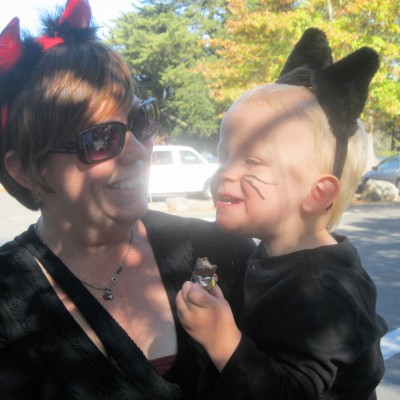
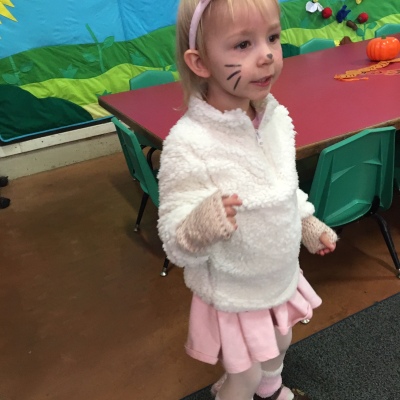
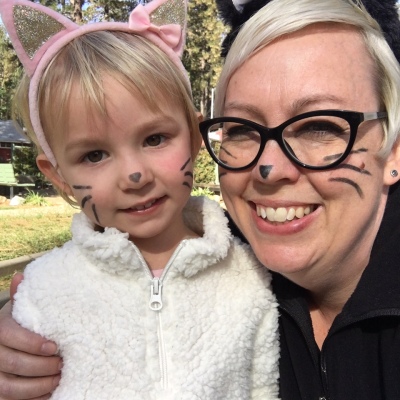
But here I am six years later. I am sitting in my car, dressed as a black cat, complete with drawn-on whiskers, because my three-year-old is at school, and I am to help with her Halloween parade. She is also a kitty, all in pink. She chose my costume so that I would be like her. The idea for her costume came from her love of the cat in the book Room on the Broom—a book of her brother’s, a gift from one of his beloved nurses. Even though he is not here, her big brother influences her. Our stories of him, the photos of him all inform her existence and my parenting. I treasure that, but sometimes I have to pause. Is my pain and grief somehow tainting how she celebrates these days? Am I wrong to let her images of her big brother color choices she makes?
As much as I have feared her living a life in Caemon’s shadow, I need not worry. This child shines in her own brilliant way, and she reminds me when I find myself lost in my grief this time of year that I have to keep celebrating. Though I was reluctant to do so, just as I have been every year since he died, she encouraged me to pull out the Halloween decorations. She reminded me that, yes, this is what we do. We display the big spiders and the cauldrons and candles and the purple lights. We visit the pumpkin patch and drink too-sweet freshly-pressed apple cider. We decorate pumpkins, first in stickers and paint, then with whichever design we opt to carve into them, and always at the last minute. We put on as many costumes as we can for the entire month of October. We eat the treats. We go to the parties. We celebrate.
And because of her brother, she gets to eat some candy despite my reluctance to give my kids sugar. Because of her brother, I go to her school and volunteer in costume even though I should be working. And because of her brother, I face this day with reverence, with poignancy, with an ache in my heart. But because of my daughter, I can finally see this holiday with joy again.
And isn’t that perfect? Halloween is a time when we celebrate the dark, when we look at the underworld and peek behind the veil to see what we don’t normally want to acknowledge. We see fear and horror and even death on parade. And to that we add the light–of sparkles and jack-o-lanterns, and, yes, little pink kitty cats. I can think of no better day to honor my two children, to see the intersection of the lost and the living, to embrace everything they are to me, to one another. And for the first time in so many years, I am grateful as can be to celebrate this day.
Nine years ago today, I was struggling to birth a nine pound eleven ounce baby boy with a knot in his umbilical cord, a baby boy who would turn me into a mom. What I didn’t know is this same baby boy would also turn me into a cancer mom, and exactly forty-one months later, this baby boy’s death would turn me into a bereaved mother at 9:00 in the morning.
Nines. They followed Caemon his whole life. He liked eight, but nine was the number of his birth month, his birth year, his birth weight, his death time. He beamed with pride each time he shared his birthdate: 9/5/09.
But with all this familiarity of nine, I don’t know my son at nine. My boy should be nine years old today, but to imagine a nine-year-old Caemon is like trying to picture San Francisco in ninety years. Some of the structures are certainly familiar, but most of it is hard to fathom. I don’t know what he would have enjoyed doing today, what sort of fabulous birthday food he would have wanted, what kinds of gifts I might have gotten him. I cannot picture him beyond his blonde hair and blue eyes—but would he still be blonde? I don’t have any idea how tall he would have been or what his nine-year-old hugs might have felt like. Nine-year-old Caemon feels impossible.
But that’s because nine-year-old Caemon is impossible.
I am five and a half years beyond my son’s death, and I hardly know how to celebrate his birthday. His favorite foods of his three-year-old days are obvious. Those red Lindor Truffles will always make their way into my home on his day, and the toasting of his favorite cinnamon bread will fill the house with its warm aroma. Beyond this, beyond talking about him and wearing crocodiles and telling his stories, it becomes harder to know how to set aside the time for my son when there is another life to be lived. And there is grief in that too.
Caemon’s little sister, his three-year-old sister, started preschool today of all the emotionally charged days. The time leading up to this has been so filled with emotion. She turned three at the end of July, and every day since, I have watched her, studied her, because this is my first experience parenting a healthy three-year-old. Two weeks before Caemon’s third birthday was his diagnosis date—just after his own first two days of preschool. He spent all but sixteen of his remaining days in the hospital.
The weaving of these milestones—my daughter starting school, Caemon’s ninth birthday—feels like a handful of tangled necklaces. I can’t figure out which bits belong to my grief and which strands belong to the normal pangs of a mother of a child growing up. To try and disentangle them feels an insurmountable task today, so I feel it all together, this big, shiny, messy muddle of love and anguish and fear and pride. It all belongs to me. It all belongs to my kids. My kids.
I rejoice in watching my three-year-old daughter conquer new fears and learn new words. I delight in her growth. It all reminds me of him though. She is just his size–his height his weight. She, like him, is not fond of babies. She, like him, has an insatiable appetite for muffin batter. And like him, she leads with her beautiful, gentle heart. But this year is where their paths diverge: Caemon will always be the memory of everything before three years and five months. But his sister will be continuing on. She will grow up. She will have friends and multiple first days of school. She will have hair, bruises that heal, and cuts that scar. She will have birthdays, lots of them. And she will have her own favorites.
Right now, her favorite number just happens to be nine.
Grief season began today. Every year as I spy August around the corner, and people start talking about kids going back to school, I start to feel incredibly uneasy. And before I know it, there it is on the calendar: August 20th, the day the crack in the ice opened up, the day the oxygen left the atmosphere, the day I learned the monster under the bed was real.
The months between August 20th and February 5th are filled with daily reminders of Caemon’s treatment. I obviously think of him in the “off” months. I grieve him openly and heartily. But August through February are peppered with memories of some of the most terrifying moments of my life, all culminating in the nightmare of losing my son.
Today, it has been six years since I rode for the first time in the back of the ambulance, my son strapped into his car seat, strapped to a gurney. Six years on, it is hard to know what to do with a day like today. I am careful these days not to relive too much of the trauma. I don’t need to sit in the moments when I was shaking so hard I couldn’t sign my name or shivering in the sweltering August heat because I was in shock. I don’t have to feel the trauma of holding him down for his first IV or the world going dark when I first heard the word leukemia. I know that I don’t have to relive the worst days of my life to see that they are there, but as this year’s grief season begins, I’m a fool to think I can avoid them entirely.
I know so many families now, so many families who have lost children to cancer, families who endured years of treatment, families for whom the entire year is filled with traumatic date after traumatic date. In this way I am lucky if there is luck to be found in losing my son. My dates are condensed, cooked down into the most concentrated and potent five and a half months imaginable. Much like Caemon’s disease. Much like Caemon’s life.
Grief season is upon me. My birthday comes soon. Then four short days after, Caemon’s birthday. There’s the day he first went back to the hospital, then Halloween, when we had to return early again. The last trip home in early December, then Winter Solstice and and bone marrow transplant and Christmas. And there is relapse, and there is his death day, and then it’s done. Grief season is over, just like that, and before I know it, I have memories free of hospitals. I have hikes in the redwoods and trips to the beach with my boy, whimsical weekends in hotel rooms, or days at home, walking to the park to swing. I ache for my son just as much during these days, but the off season is lighter, less shrouded. I can breathe.
But grief season is here with its dark, heavy cloak, and tonight, as I sat with the heaviness of that familiar garb, I lit a candle in front of Caemon’s photo. I touched his face. I spoke with him. I wished so hard that I knew what he would be like now. I apologized to him that I couldn’t save him, and then I walked away for a moment. I wandered my house looking for something to hold, feeling my arms were empty. I scanned the room looking for something of him to hold. I walked into my room, earnestly searching, for what, I did not know. But my son was not to be found. His ashes rest in his box on the mantle, but this box, the crocodiles, even his favorite teddy bear, none of it were what my arms craved. I panicked for a moment. What could I hold? Finally, I stopped. I stood again, staring at his photo, held my arms out as if to welcome his embrace, pulled them back to my chest, empty, and wept.
Christmas is over in just a few minutes, and I am so very relieved. As an adult, I have never been one to immerse myself in the Christmas season, but I do enjoy the particular festive and cozy feelings associated with this time of year. When Caemon was with us, I was starting to learn how to show him the magic of the season, or rather, he was showing me.
I remember when he was two, my parents took our whole family Christmas tree hunting in the forest. We bought a permit, and got ourselves a truly majestic cedar, which my dad strapped to his truck and brought to us all the way in Santa Rosa. Caemon was impressed with every step of the process: the walk to find the tree, the chainsaw necessary for cutting it, the fact that Grandpa not only drove it to our house, but carried it inside! My son would turn the lights on and off, recount the story of his grandfather bringing the tree to us, marvel at the tree’s beauty.
That same year, my tiny chef got his own little kitchen, placed right there in front of that tree on Christmas morning. I spent so much of that morning in tears seeing my son reveling in the joy of the season. We played Christmas music, drove around to look at lights. It was magic because I could see it through his eyes. Through his eyes, it was all so beautiful.
It has now been five years since I spent a Christmas with my son, and it is the third holiday season I have spent with his lovely little sister. This year, she is nearly two and a half, just a little older than he was that magical December, and like him, she gets it. I took her myself to find a live tree. She is obsessed with the song “Rudolph the Red-Nosed Reindeer,” and she loves Caemon’s beautiful carousel. In fact, so much of her Christmas magic comes from Caemon: the shiny metal tree from his days in bone marrow transplant, so many of his ornaments, the carousel with lights and music, the glowing angel we bought the year he died. So it makes sense that as I talk about Christmas with my daughter, I am regularly mentioning her brother. And the more I mention him, the more I relive these moments, the more I wish he were here.
For the past couple of years, I have held it together at Christmas. I have been mostly okay, but this year, I have been wearing my lead apron full time.
For each birthday and Christmas since she was born, my daughter has received at least one gift from her brother, something from his wonderful stash of toys. This year, I wanted to give her three things, but the most significant was his train set. This train set Caemon got when he was her age, and we spent countless hours on the floor arranging the track just so. When he died, the train was packaged up into a small box marked “Train,” and it has floated from one house to the next just waiting to emerge again.
Last night, I cut the tape on the box and opened it up. The track was so much more pristine than I imagined it would be. It is all so clean. I sat on the floor, beneath our tree, and I assembled the train track in a figure eight, tears creeping down my cheeks. The last time I touched those tracks, my son was alive. I moved the train along, over the bridge, around the entire track as I thought of him and how much he loved it, and I hoped his sister would too.
But this morning, as is perfectly normal for toddlers, my daughter was interested in other big things–in fact, she was interested in everything but the train–and I was okay with that. I was fine that she scarcely looked at the train because I know she will eventually. I was fine with every perfect thing she did to take in the day. But I was not fine.
That lead apron pressing on my shoulders and my chest kept me close to the ground all day. I would buoy myself long enough to read a new stack of books with my girl only to plummet into anguish that he wasn’t there to help read to her. I would watch her playing so contentedly by herself and then curse the universe for making her an only child, sinking and sinking lower still. I spent the day bobbing on the roughest of seas only to be pulled under over and over again by the cold, lonely waves of missing my boy, not just for me but for her.
I will never know a raucous Christmas morning with my children. I will only know the quiet wonder of my only living child showing me her way through this season. As I wept today, I worried that I was somehow marring this day for her, that she would grow up associating it with Mommy crying, with something, someone always missing. I suppose in some ways this will be true. I know there will be years when it doesn’t hit as hard. Maybe five years is just too long. Maybe the two-year-old’s Christmas is just too poignant. Maybe I’m feeling just a little extra broken. And maybe next year will be better.
But today, no matter how much I wanted to salvage the day for my daughter, I just couldn’t fight the weight of it all: the heaviness of missing what I will never have, the acceptance yet again that nothing is going to bring me my eight-year-old son. I had to give myself permission to be an imperfect mother, to honor my son and my loss and my pain even as I witnessed my daughter’s unsinkable wonder and joy.
This was Caemon’s favorite number. I have written of it before. Sometime in his third year, he decided that every series of numbers led to eight. He knew how to count, but he loved throwing in “Eight!” with his sly smile and twinkle in his eye at random intervals in his counting to ten.
But I do not know my eight-year-old son. I do not know what it is to parent an eight-year-old Caemon. What does he like? Is he annoyed by his sister? Who would his friends be? How would he like school? I think of all the things I know about him at three, and it’s so much. Adding five years to that seems like an entire lifetime. It’s more than an entire lifetime when Caemon’s life is the measure.
There is a reaching my brain does to understand who he would be. I look at other kids who were born around the same time. I study their faces, how they are sharpening and wonder how his would have compared. I look at how they speak to one another, what they laugh at, and if this is how his own sense of humor would have evolved too. I watch and I watch as these children grow, as they turn eight, and I hope to catch glimpses of my own eight-year-old son in their eyes, in their clothes, in their smiles. But it’s a fruitless act. Caemon’s chiseled cleft chin would have been his own. His platinum hair would likely have still been white as can be. His sparkling blue eyes would have continued to shine light on his world. But beyond this, I cannot know. I will never know.
And at times I consider that Caemon would have been different too. He underwent serious treatment for his cancer, a bone marrow transplant. He wasn’t really growing as he should have after treatment started. Maybe he wouldn’t have been tall like his peers, like I always thought he would be. But again, this is fruitless. I will never know, can never know.
My son is not eight. He is forever three years and five months.
But I think I know that Caemon would have liked being eight, and I think I know that he would have liked being a big brother to his spark of a little sister. And I think I know that he would have cooked and loved outside and loved music and loved his people as much as he ever did. And I know he would have loved me and looked out for me. It’s the construct I can make of him. It’s my own imaginary age progression sketch made up of far too few memories and a mother’s simple knowing.
Tonight, I took my daughter to the market so that we could buy Caemon’s favorite treats, and I told her, “It’s Caemon’s birthday.” She merrily repeated throughout the store, “Caemon’s Birthday! Caemon’s Birthday!” And she continued in the car on the way home. She stopped after a few moments and said, “Want to go see Caemon. Visit Caemon.” And through my tears, all I could say was, “So do I, baby girl. So do I.”
Happy birthday, my beautiful boy, my chubby cherub, my little crocodile, my firstborn, the brightest light I ever saw—wherever, whomever, whatever you may be. I will always love you.
For three years, I have had it wrong. For three years, until today, I somehow believed my son’s diagnosis anniversary was the 21st of August. This year, as with the past three, I have been dreading this date, and I spent some time today wondering how I might feel approaching my son’s fifth diagnosis anniversary. But then a Facebook memory popped up today, a blog post from four years ago about the first anniversary. On the 20th.
I combed back through old blogs. I looked at a calendar from 2012. I sat in disbelief, so utterly confused in my mind and my heart because the fact is, we learned my son had leukemia five years ago today. Five years ago today we took that ambulance ride to UCSF and had our first sit-down in a late-night hospital hallway. Five years ago today, my blood ran cold in a way I never knew it could, and I shook, hard, as I signed waivers and permissions and watched my son, wondering if he would survive. How could I ever forget this day? Jodi reminded me that there was little sleep that night, that one day bled into the next, that dates on paperwork probably stated the 21st, but still I’m baffled because here I am, a little blindsided yet again by one of the worst days of my life.
And now we are five years on. Tomorrow, the day I thought for three years was D-Day, a large swath of the U.S. will experience a total eclipse of the sun. I was listening to an interview with an anthropologist about the eclipse the other day, and she asked the audience to imagine what it must have been like for indigenous Americans out on the plains hundreds of years ago, seeing what appeared to be a hole opening up in the sky where the sun once was, watching their worlds go black for a few minutes only to see the sun return, their worlds gradually return to normal, only with the added knowledge that their sun could be swallowed up at any time, and they would be powerless to it.
You never forget the day a hole opens up in the sky and swallows the sun. You never forget the day that everything changes in an instant without any warning, and you never return from such an experience the same.
I know far too many cancer moms now, so many whose kids have died and many whose kids have survived, and for every last one of us, regardless of outcome, diagnosis day is the day the earth turned dark, the day we learned that a hole can open up in the sky, and we are powerless to change it.
How I remembered that day incorrectly sometime a couple of years out, I’ll never know, and I know dates don’t really matter. It’s the feeling of it, the changing of the light, the start of school, the lengthening of shadows, the nearing of his birthday, the pit in my stomach; they’re all signs, aren’t they?
Five years ago today, I drove my son to the ER. I watched him get his first IV. I sat with him as an ambulance drove us across the Golden Gate Bridge, and into the children’s hospital and up to 7-Long where the hematology and oncology team awaited our arrival. Five years ago, that hole opened up in my sky, and for five and a half months it got bigger and darker and scarier than I ever imagined it could. Five years today marks the beginning of Caemon’s end, the day that cast a permanent shadow across my heart.
Three months prior to his diagnosis, we experienced a partial solar eclipse. Caemon made mud muffins as we sat outside to observe it. I didn’t know it, but my boy had leukemia here.
Tomorrow I am flying to Austin, Texas to parent my son.
These days, my time is spent so much in the present. I wake up early with my neary-two-year-old daughter. I make breakfast, clean up spills, change diapers, negotiate nap times. I plan classes and help eighteen-year-olds navigate the challenges of going away to college. I teach the tedious art of semicolon usage. And I work tirelessly at improving myself, whether it’s improving my mental or physical health, finding time to sleep, finding time to read. Even finding joy.
But never do I get to parent my boy.
In fact, it is devastating to admit that while Caemon’s name is always on the tip of my tongue, there are many days that go by when I don’t sit with my memories of him, days that go by when I am so busy I am numbed to the depths of my loss.
This is natural, of course. Time heals, they say. I am not sure I have healed any more than one heals from an amputation. Yes, the initial wound is gone, covered in scar tissue, but the limb is still missing. The boy is still missing. My boy. My son.
How does one care for a piece of oneself that has ceased to be? How does one mother a child no longer on this earth?
It is our nature as mothers to want to continue parenting. When Caemon died, I went back to teaching, and suddenly my students were my surrogate children. But it was never the same. Still, I went on yearning to mother until my daughter came, and then I learned that I was aching to mother two children, but not any two. My two. My boy. My girl. My kids. (Oh, how good it feels to write that in the plural.)
I find my way to two-child parenting when I can. I have learned that I can share my son with my daughter. She says his name so beautifully. She begs to look at his photo books, delights in watching his videos. I will involve her in his legacy as much as she is inclined, but there comes a time when a mom wants to give her attention to just one child at a time. And this is why I find myself flying to Texas.
On Sunday, I will shave my head with the 46 Mommas—my tribe of cancer moms, too many of whom have also lost children. I will cry. I will think constantly of my son. I will leave my little girl with her other mom so that I can do this wholly and without worrying her gentle heart. I will watch Caemon’s videos and play his music and listen to his voice and talk about him day and night. I will say his name over and over without apology.
Next year, I’ll fly to another city, and I’ll do the same. I will keep raising money in his name, keep raising awareness and using his beautiful smile to draw people in. It’s what I have left. It’s one real way I can parent my son.
Mommy and Caemon
Should you want to donate to my shave fund, which funnels to Caemon’s Hero Fund for JMML research, please follow the link below:


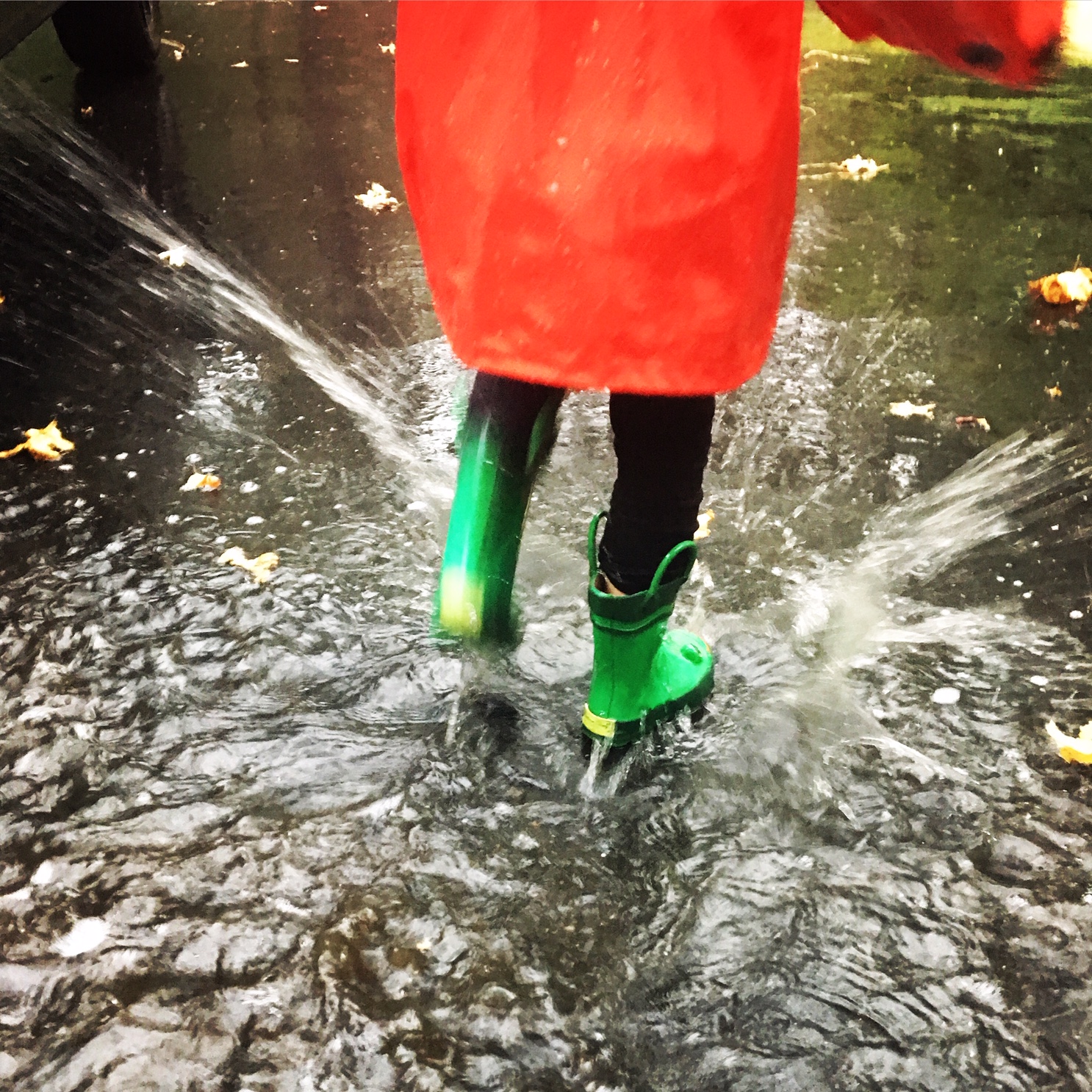 Of course, the differences span far beyond her health as we enter these unfamiliar months while she continues to grow and develop and learn. My daughter sings “Rudolph the Red-Nosed Reindeer” and dances her own made up “dragon dance.” She is obsessed with dinosaurs and horses, and she plays with toys and (usually) not medical supplies. She stomps in puddles and dresses in costumes and loves to get messy. She is making friends who are children (without one nurse or syringe pump among them), is on her first winter break, had her first holiday performance at school. And like most little sisters, she looks up to her big brother, tries to emulate him through her interpretation of who he was. Each day of her 1,250 on this planet thus far, she has reminded me that she is her own person and always will be. There is no danger of her taking on the role of replacement child, and as each day passes, I believe I may very well see her grow up.
 Six years ago today, I also had a three-year-old with whom to celebrate Halloween. Caemon was dressing up as his favorite superhero: a nurse. He had scrubs the same shade of blue as his nurses, a pretty amazing counterfeit UCSF ID, a surgical mask, and a bald head to match all the nurses who cared for him.
 UCSF telling us we would need to come back that night, telling us to take him trick-or-treating first, telling us they would make it special for him when he arrived. I remember walking him in the rain to four houses in our neighborhood, the rain on my face hiding the tears that were flowing freely. As the neighbors handed him very special treats, I remember wanting so much just to have a normal Halloween for my boy, a normal childhood, a normal anything.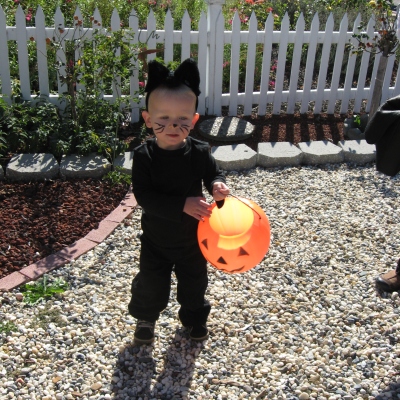
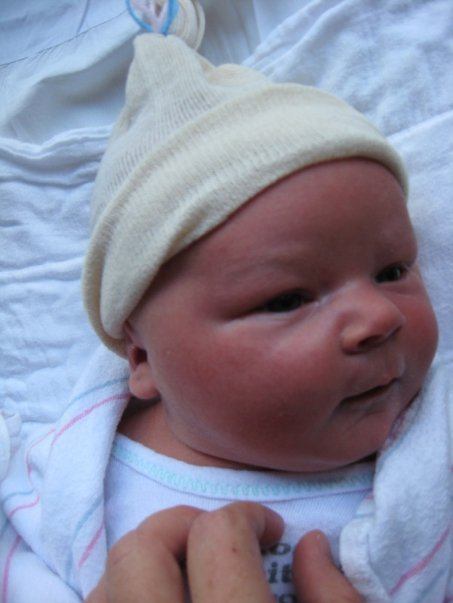 Nine years ago today, I was struggling to birth a nine pound eleven ounce baby boy with a knot in his umbilical cord, a baby boy who would turn me into a mom. What I didn’t know is this same baby boy would also turn me into a cancer mom, and exactly forty-one months later, this baby boy’s death would turn me into a bereaved mother at 9:00 in the morning.
 Christmas is over in just a few minutes, and I am so very relieved. As an adult, I have never been one to immerse myself in the Christmas season, but I do enjoy the particular festive and cozy feelings associated with this time of year. When Caemon was with us, I was starting to learn how to show him the magic of the season, or rather, he was showing me.
 It has now been five years since I spent a Christmas with my son, and it is the third holiday season I have spent with his lovely little sister. This year, she is nearly two and a half, just a little older than he was that magical December, and like him, she gets it. I took her myself to find a live tree. She is obsessed with the song “Rudolph the Red-Nosed Reindeer,” and she loves Caemon’s beautiful carousel. In fact, so much of her Christmas magic comes from Caemon: the shiny metal tree from his days in bone marrow transplant, so many of his ornaments, the carousel with lights and music, the glowing angel we bought the year he died. So it makes sense that as I talk about Christmas with my daughter, I am regularly mentioning her brother. And the more I mention him, the more I relive these moments, the more I wish he were here.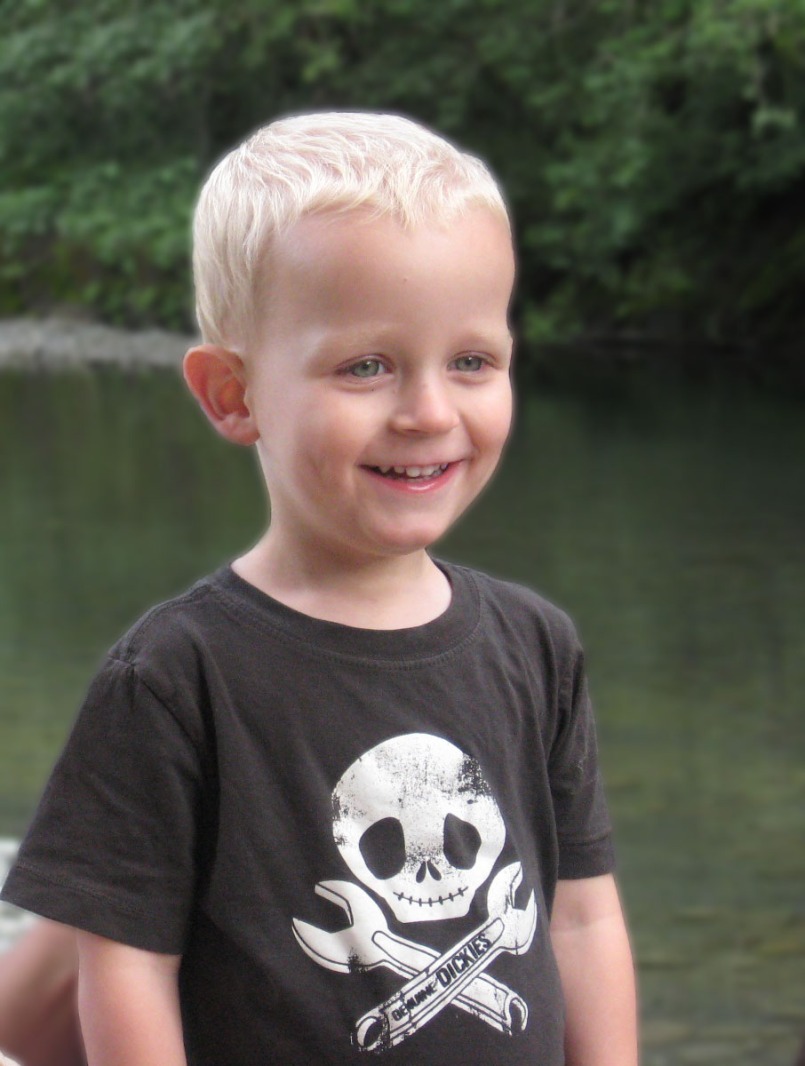


 C is for Crocodile